










The catastrophic explosion at the Chernobyl Neclear Power Plant forever changed our understanding of British skies with the Met Office continuing to use the lessons learned from the fallout to this day: from tracking volcanic ash to giving pollen forecasts.
On April 26, 1986, a blast tore through Chernobyl Reactor 4, releasing vast quantities of radioactive material into the atmosphere.
Winds carried the contaminated plume west across Europe, eventually reaching the United Kingdom, leaving meteorologists scrambling to predict its path, with rainfall a particular concern given its ability to deposit radioactive material on the ground.
The disaster, which marks its 40th anniversary today, remains one of the most significant environmental events of the 20th century.
Its impact went well beyond the immediate contamination fears, changing how scientists, and more importantly for Britain, meteorologists, understand and model the movement of hazardous material through the atmosphere.
At the time, it exposed clear limitations in the tools available for tracking airborne contamination over long distances and extended periods as existing methods struggled to deal with the complexity of real conditions such as shifting winds, turbulence, rainfall and interactions at the Earth’s surface.
In the aftermath, the Met Office was tasked with developing a more advanced modelling capability.
The aim was to build a system capable of simulating how hazardous material moves, changes, and is removed from the atmosphere across scales from local to global.
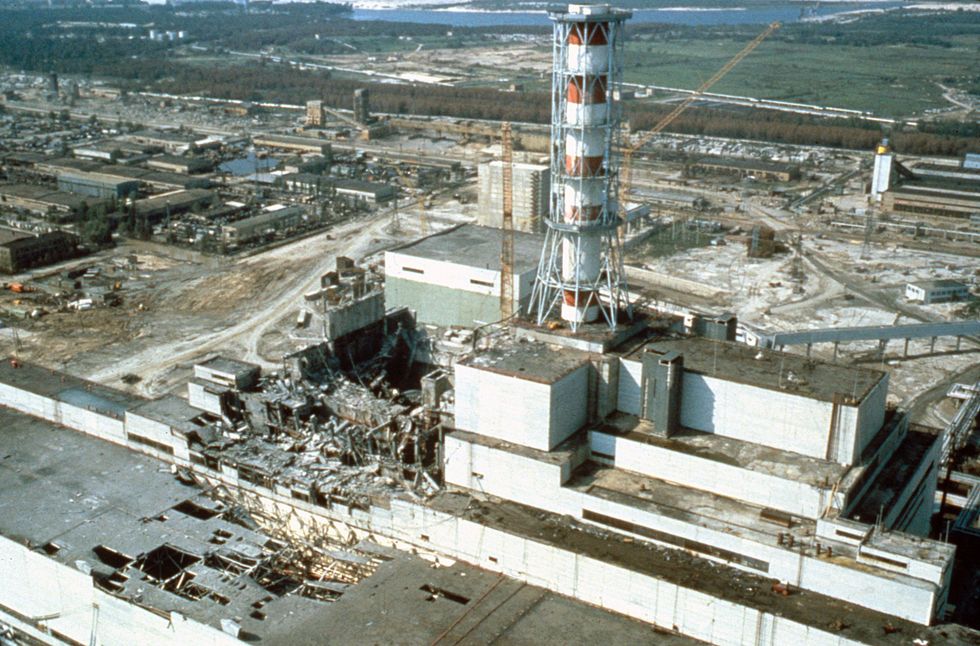
It is the 40th anniversary of the catastrophic explosion at Chernobyl’s Reactor 4, an event that reshaped Britain’s approach to monitoring airborne hazards
|GETTY
This work led to the development of the Numerical Atmospheric-Dispersion Modelling Environment (Name).
The system was designed to be flexible, enabling continual refinement and application across a wide range of scenarios.
At its core is a Lagrangian particle approach, in which pollutants are represented as thousands to millions of individual particles moving through a simulated atmosphere.
Each particle follows the wind while also experiencing random motion to represent turbulence.
This avoids making assumptions about how a pollution plume will spread or evolve.
Jim Dale, meteorologist for The British Weather Services, told GB News: "I remember it well. I remember the concern and sometimes the panic that followed the explosion, with all eyes cast towards the skies, the weather forecasts and the wind speed and direction over the next fortnight or so, which at the time wasn’t favourable for the UK, with concern about the radioactive fallouts.
"This was a stark reminder that whatever the concern, whatever the cause, and whatever the fallouts, we come a very poor second to the whims of the weather.
"The NAME model, meanwhile, is a very important and useful technological advancement in terms of plotting and anticipating whatever might come our way and for other countries too, but the bottom line is that in itself it won’t stop it, if something major like that happens again, we are at the mercy of the gods."
LATEST DEVELOPMENTS:
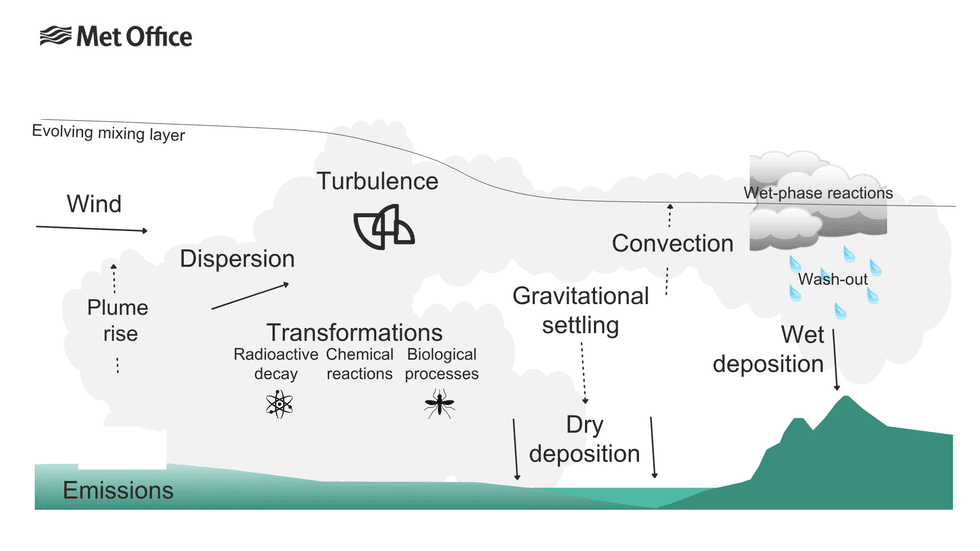
The Numerical Atmospheric-Dispersion Modelling Environment is commonly known as Name
|MET OFFICE
Alongside this, Name also includes an Eulerian framework, better suited to more uniform pollutants such as ozone.
Using both approaches allows the model to balance detail with efficiency.
Name can be applied to a wide range of substances, including radioactive material, volcanic ash, chemical pollutants and fungal spores.
This makes it useful for understanding both immediate hazards and longer-term environmental effects.
Although developed in response to a nuclear accident, its use has broadened considerably.
It now supports aviation by forecasting volcanic ash clouds, helps predict pollen levels several days in advance, and is being developed further for air quality forecasting.
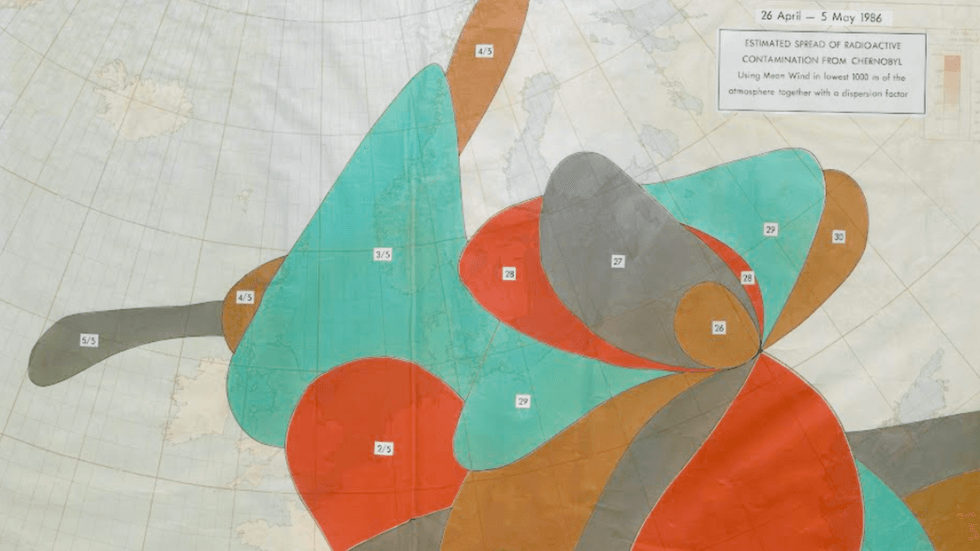
Historical map showing the estimated spread of radioactive contamination from Chernobyl
|MET OFFICE
It is also used to estimate greenhouse gas emissions and ozone-depleting substances, supporting climate research and international reporting.
Today, Name is used not only by the Met Office but also by universities, Government bodies and meteorological services around the world.
An annual Name User Workshop brings together scientists and practitioners to share developments and improve understanding of atmospheric dispersion.
Speaking to the People's Channel, Alan Owen, the founder of LabRats International (Legacy of the Atomic Bomb Recognition for Atomic Test Survivors), said: "The disaster spread fallout across not just the local area, but across the world.
"Lives were lost and continued research in 2026 shows that the children of the workers are experiencing DNA mutations and this is why we are calling for research into the descendants of the nuclear test veterans, the civilians, scientists and indigenous people who have been affected by the tests."