










Labour has been urged to reflect on its controversial expansion of "EdTech" within classrooms after Sweden — a pioneer in the field — reversed course on digital learning, shifting back to pen and paper.
Last month, Bridget Phillipson announced a £23million initiative to implement artificial intelligence (AI) tutoring systems across England's secondary schools as early as this summer.
But the Education Secretary's announcement was met with concern from online safety groups and parents, who argued "Big Tech" giants may be promoting digital dependency.
And with dozens of countries moving students off digital devices and onto books and handwriting, experts question whether now is the appropriate time for the Department for Education (DfE) to be trialling "teacherless" classes.
Technology has become an inescapable part of everyday life for youngsters across the UK, with nine out of 10 children owning a smartphone, according to Ofcom.
With so many pupils having phones in their pockets, the UK Government's decision to expand digital hardware, software and AI-driven platforms into educational practices comes as no surprise.
However, a cautionary tale for the UK — and its hopes for a digital-first classroom — can be found by looking at Sweden.
The Scandinavian country is regarded as one of Europe’s most technologically savvy countries, with laptops becoming mainstream in Swedish classrooms in the late 2000s. By 2015, around 80 per cent of young Swedes at state-funded high schools had access to a digital device.

A cautionary tale for the United Kingdom — and its hopes for a digital-first classroom — can be found by looking at Sweden
|GETTY
Then, in 2019, tablets became compulsory in Swedish preschools to prepare children for the future in an age of rapid technological change. However, Sweden's right-wing coalition, which came to power in 2022, has reversed those rules.
Last year, Sweden's Ministry of Education and Research implemented rules allowing “only analogue learning tools, such as books, should be used for children under the age of two and that potential use of non-analogue learning tools should be greatly restricted for all other children".
The new guidelines aim to “get back to basics and re-establish a strong knowledge-based school system with the focus of early grades being on basic skills such as reading, writing and arithmetic".
Ulf Kristersson, Sweden's Prime Minister and leader of the Moderates, has coined the phrase "från skärm till pärm” (from screen to binder), arguing computer-free lessons create better conditions for young people to thrive and gain cognitive skills.
Stockholm's shift in stance followed a 2023 consultation involving academic researchers, teaching organisations and public agencies.
Dr Sissela Nutley, a neuroscientist affiliated with the Karolinska Institute based in the Swedish capital, raised concerns about the use of technology within schools.
She pointed to research showing reading on a display is less effective than on paper, as well as evidence proving screen use affects infant development.
In 2012, Sweden plummeted 10 places in the Programme for International Student Assessment (PISA) rankings.
LATEST DEVELOPMENTS
- 'He should clear off!' Britons launch furious tirade on 'useless' Keir Starmer amid mounting pressure to resign
- Universal Credit claims hit record 8.3 million as Labour faces growing welfare crisis
- Labour blamed for delaying 100 million barrels of North Sea oil as investment 'could collapse before 2030'
Another drop followed in 2022, with Sweden falling behind global rivals such as the United States, Finland and Denmark in mathematics and literacy, with a quarter of 15- and 16-year-olds having no basic reading comprehension.
Sweden is not alone in their thinking: Nordic neighbours Norway and Denmark are also reevaluating the use of technology in schools, while South Korea is enforcing screen time limits for students.
Unesco, Unicef and the International Telecommunication Union (ITU) recently released a charter encouraging policymakers “to establish, improve, and sustain digital learning platforms that support education as a human right and a public good".
In Britain, concerns have been raised about the absence of a single safety framework for students. According to Whitehall officials, EdTech can vary from “management information systems, collaborative online platforms and one-to-one devices for learners” to “a formative assessment tool".
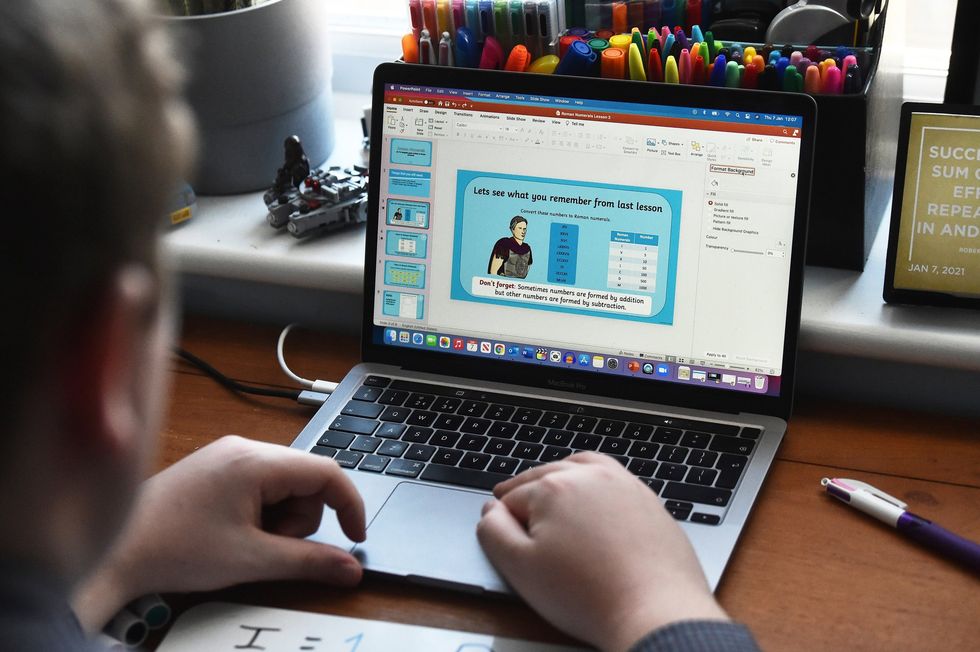
There are growing concerns from online safety groups and parents, who argue Big Tech giants may be promoting digital dependency
|GETTY
Rahim Hirji, a former EdTech advisor and author of SuperSkills: The Seven Human Skills for the Age of AI, told GB News: “There is still no national certification framework for AI tools being sold into schools.
“At the moment, any company can market an AI product to a headteacher without independent verification of its safety, what it does with data, or whether there's any evidence it actually improves learning.
“We don't let schools buy food that hasn't been inspected... so why are we letting them buy AI tools that haven't been safety-certified?
"Schools are being asked to carry out a level of due diligence that most don't have the expertise or the time to do properly.
“The profit motive in Edtech is real: venture-backed companies are under pressure to grow and schools are an attractive market.”
Rob Cowen, a Teach First ambassador, told the People's Channel: “Schools are rightly concerned about data privacy and face an uphill battle with students using AI to cheat.
“The easiest fix for the latter is for students to work on pen and paper in the classroom without device access.
“Laptops or iPad trolleys tend to be shared between classes, so use in most subjects is the exception, not the norm.
"Students certainly enjoy access to the technology.
"Nevertheless, its efficacy versus more analogue methods is debatable.”
When asked what concerns were raised by schools, Mr Hirji said: “The concern I hear most from teachers is around data: where does student work go? Is it being used to train commercial models? Who owns it?
"These are not paranoid questions... and headteachers are often personally liable if something goes wrong with a tool they don't fully understand."

Bridget Phillipson announced a £23million initiative to introduce artificial intelligence tutoring systems in secondary schools
|GETTY
The Digital Futures for Children’s Centre, a joint research hub between the London School of Economics and Political Science (LSE) and 5Rights foundation, concluded: “There has been insufficient consideration for the growing concerns about EdTech's lack of data compliance.
"Allowing data companies to harvest and use children's data infringes upon children's rights to privacy and freedom from commercial exploitation.
"This has potential adverse impacts on children's equity, inclusion, safety and wellbeing.
"Moreover, the claimed educational benefits of EdTech remain largely unproven.”

Ulf Kristersson, Sweden's Prime Minister and leader of the Moderates, has coined the phrase "from screen to binder"
|GETTY
The use of Edtech has significantly increased since the coronavirus pandemic, with many schools continuing its implementation in classrooms after lockdown restrictions were lifted.
Platforms such as Moodle and Canvas were used by teachers to deliver lessons and track students' progress.
However, the Digital Futures for Children’s Centre found just 20 per cent of teachers evaluate the technology they use within classrooms.
Meanwhile, a new study from the Centre for Social Justice (CSJ) think tank found pupils sitting their Standard Assessment Tests (SATs) are spending three hours a day online.

Technology has become an inescapable part of everyday life for youngsters, with nine out of 10 children owning a smartphone
|GETTY
Lord Nash, who served as the Parliamentary Under-Secretary of State for Schools at the Department for Education under the Conservatives, said: “We are raising a generation of children who can swipe before they can throw, scroll before they can run, and who are paying the price in their physical and mental health.
“Children need to be off their phones and outside playing, moving (and) building the strength and resilience that an active childhood provides.”
A petition by SafeScreens co-founder Jane Rowland, which is designed to stop the use of educational technology within schools and early-years settings, has gained nearly 7,000 signatures.
It states: “We feel that 1:1 devices and EdTech platforms have been rapidly adopted by schools despite virtually no evidence of net learning benefit.
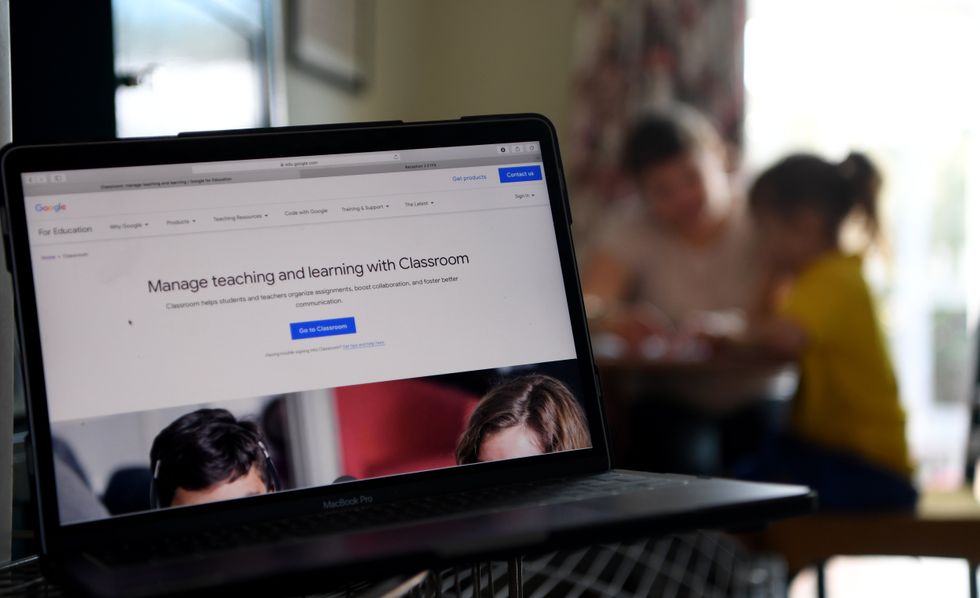
The use of Edtech has significantly increased since the pandemic, with many schools continuing its implementation in classrooms
|GETTY
“Many teachers feel uncomfortable using AI for lesson planning, as if they're somehow cheating.
"That tells you something important: the profession hasn't been given a clear sense of what appropriate use looks like.
"AI has moved significantly even in the last 12 months, so these policies need regular review.
"What was reasonable guidance 18 months ago may now be completely inadequate: most schools simply don't have the bandwidth to keep up with that pace.”

Conservative peer Lord Nash served as the Parliamentary Under-Secretary of State for Schools at the Department for Education
|PARLIAMENT.TV
Lord Nash also urged Downing Street not to "dimiss" the decisions taken by Sweden, with the Tory peer stating: “What they recognised is that screen-based learning in primary schools wasn't producing what it promised and that handwriting, reading physical books and unmediated human contact were being quietly undervalued.
"Going back to basics there wasn't anti-technology: It was an evidence-based decision.
“I think the UK is moving in a similar direction, even if we don't quite say it that way.
"The Government has already moved to make schools phone-free by default, with Ofsted now taking into account how consistently that's applied... The era of schools adopting technology without really questioning it is ending.”

The Digital Futures for Children’s Centre is a joint research hub between the London School of Economics and 5Rights foundation
| PAResearch into the effects EdTech is having on children is underway.
Leanda Barrington-Leach, Executive Director at 5Rights, said in a statement: “Amid the debate around social media bans, the impact of EdTech is flying under the radar, but many of the harmful design features which are causing concern about social media are also present in some EdTech apps – features that can damage children’s health, development and relationships.
“In the absence of regulations or clear guidance to help schools understand what good looks like, we first need to get a grip on what tech is being used in the classroom to understand whether it really is benefiting children and their teachers, and this is something 5Rights is working on.”
Britain's News Channel has approached the Department of Education for comment.
Our Standards: The GB News Editorial Charter